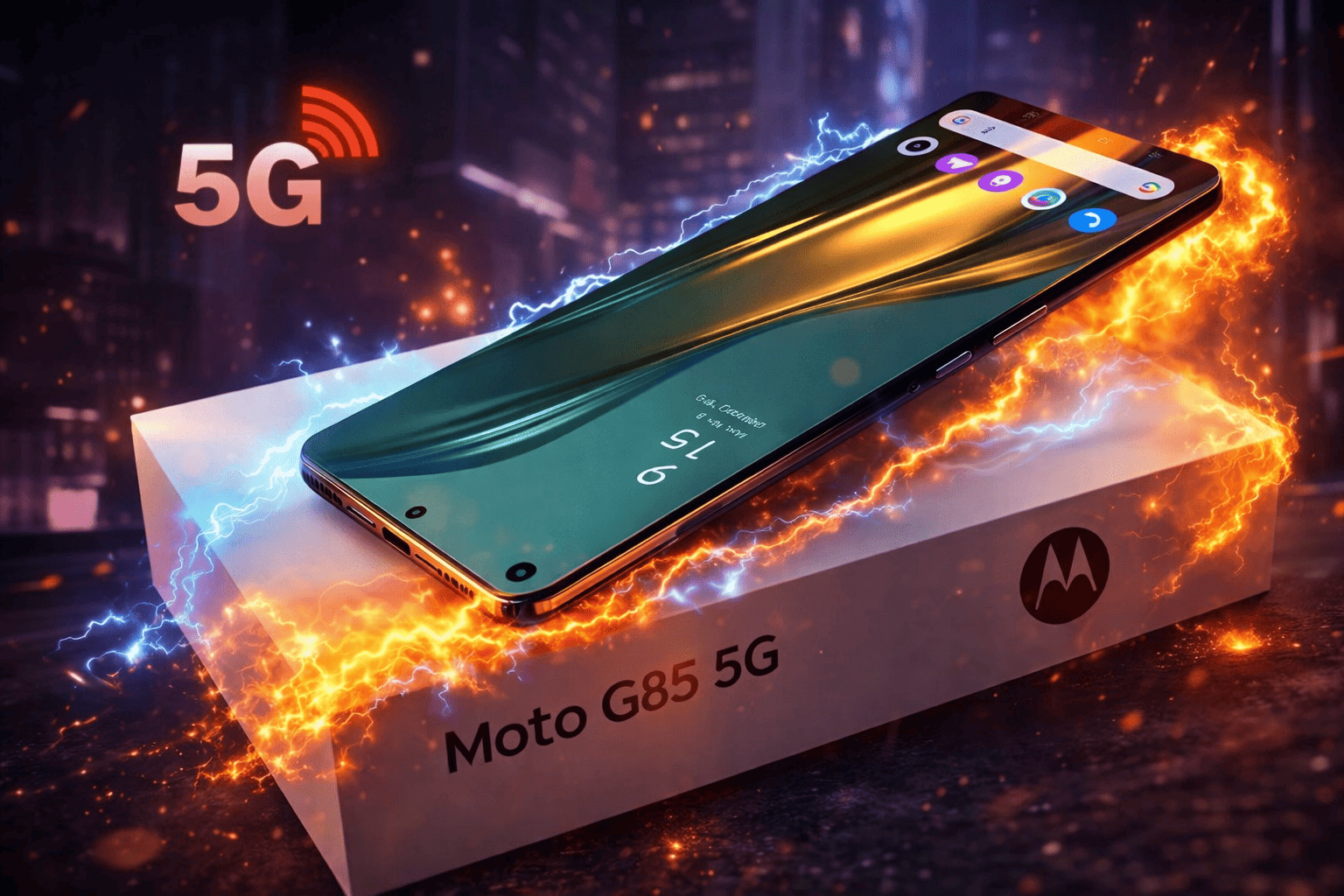
Motorola’s new Moto G85 5G arrives with a spec sheet that seems to break every rule in the budget phone playbook: a 250MP AI camera, 144Hz AMOLED display, and an 8000mAh battery, all for a starting price of ₹11,899. It promises flagship-level features without the flagship price tag, directly targeting value-hungry gamers, content creators, and power users.
But in the world of smartphones, unbelievable specs often come with hidden compromises. Can a phone this affordable truly deliver on such extravagant promises? We’re separating the marketing genius from the real-world performance to see if the Moto G85 5G is a genuine game-changer or just a cleverly packaged illusion.
Design & Build Quality
The Moto G85 5G features a sleek, modern design with a curved vegan leather or glossy plastic back (depending on variant). It feels surprisingly premium in the hand for its price, though the plastic frame is a give-away. The first thing you’ll notice is its substantial weight and thickness, a direct result of housing the massive 8000mAh battery. It’s not uncomfortable, but it’s far from a lightweight device.
The 144Hz AMOLED Display: Smooth but With Limits
Specs: 6.78-inch FHD+ (1080 x 2400) pOLED, 144Hz refresh rate.
The display is a major highlight. A 144Hz refresh rate on an OLED panel at this price is exceptional. Scrolling is incredibly smooth, and animations feel fluid. The colors are vibrant, and blacks are deep, making it great for videos and gaming.
The Reality Check:
- Brightness: Peak brightness is adequate for indoor use but may struggle in direct sunlight. Don’t expect the ultra-high brightness of more expensive phones.
- Processor Pairing: While the 144Hz is smooth for the UI, the mid-range processor may not push 144fps in demanding games. The benefit is more in everyday smoothness than hardcore gaming.
Verdict: You get fantastic smoothness and good color for the price, with minor trade-offs in outdoor visibility.
The 250MP AI Camera More Than Just a Number?
This is the headline act. A 250MP sensor (likely a version of Samsung’s ISOCELL HP3) sounds like overkill.
How It Really Works:
- Pixel Binning is Key: By default, it combines pixels to shoot brighter, more stable 12.5MP or 50MP photos. The full 250MP mode is for ideal lighting only and creates huge files.
- Hardware Limits: The lens quality and image signal processor (ISP) in a budget chipset can’t match a true flagship. The AI software does heavy lifting to enhance detail and color.
- Performance: Daylight photos will be very detailed and share-worthy. Low-light performance will be decent due to pixel binning, but noise will be visible compared to phones with larger physical sensors.
Camera Truth Table:
| Feature | Promise | Real-World Outcome |
|---|---|---|
| 250MP Mode | “DSLR-like detail” | Useful for cropping in perfect light; creates 60+MB files. |
| Everyday Photos | “AI-enhanced clarity” | Relies on 12.5MP/50MP binned shots. Results are very good for social media. |
| Low-Light | “Advanced night mode” | Acceptable, but can’t beat larger sensors. AI processing is aggressive. |
| Ultra-Wide & Depth | “Complete system” | Typically an 8MP ultra-wide and 2MP macro—usable but basic. |
Performance & Software
Specs: Expected Qualcomm Snapdragon 6s Gen 3 or MediaTek Dimensity 7050 equivalent, with 8GB/12GB RAM, running Android 15.
- Performance: The chipset is built for efficiency and reliable 5G. It handles daily tasks, social media, and moderate gaming (e.g., BGMI at medium settings) very well. It is not a hardcore gaming chip. The 144Hz display will feel smooth in lighter games and menus.
- Software Advantage: A near-stock Android 15 experience is a huge plus. It’s clean, bloat-free, and feels fast. Motorola’s update promise (likely 2 OS upgrades + 3 years security) is decent, though not class-leading.
- Therals: The large body helps with heat dissipation during longer use.
The 8000mAh Battery
An 8000mAh battery is the phone’s superpower.
- You can expect 2.5 to 3 days of moderate use or 1.5 to 2 days of heavy use (gaming, videos).
- Battery anxiety is virtually eliminated.
The Critical Compromises:
- Weight & Size: The phone is thick and heavy.
- Charging Speed: Even with “fast charging” (likely 30W or 45W), recharging 8000mAh takes a long time. A full charge could take over 1.5 hours with a compatible fast charger. With a standard charger, it could take 4+ hours. Always check if the fast charger is included in the box.
The Honest Breakdown
Pros:
- Unmatched Battery Life: The 8000mAh is a true game-changer.
- Excellent Display Smoothness: 144Hz OLED is rare in this segment.
- Clean Software: Stock Android 15 is a joy to use.
- Strong Daylight Camera: The 250MP sensor delivers great detail.
- Exceptional Value: The spec sheet for the price is impressive.
Cons:
- Bulky and Heavy Design: A direct trade-off for the huge battery.
- Camera System Limits: Low-light and ultra-wide performance are average.
- Slow Full Recharge: Charging the massive battery to 100% takes time.
- Performance Ceiling: Not for users who need the highest gaming frame rates.
Who Should Buy It?
The Moto G85 5G is a masterclass in targeted value. It makes clear trade-offs to excel in areas budget users care about most: battery, screen smoothness, and clean software.
Buy the Moto G85 5G if:
- Your #1 priority is battery life that lasts for days.
- You love a smooth, clean Android experience.
- You are a moderate user who enjoys media and light gaming on a great screen.
- You take most of your photos in good lighting.
Consider other options if:
- You need a lightweight, pocketable phone.
- Low-light photography is critically important.
- You are a hardcore mobile gamer.
- You need the absolute fastest charging available.
Bottom Line: The Motorola Moto G85 5G (2025) is a phenomenal value package. It’s not a flawless flagship, but for ₹11,899, it delivers a combination of endurance, smoothness, and camera detail that is incredibly hard to beat. It’s a phone built for real-world use, not just spec sheet wars.
Moto G85 5G 2025
Q1: Does the 250MP camera take better photos than a 50MP camera?
A: Not necessarily. In good light, it can capture more detail for cropping. However, overall photo quality depends more on the sensor size, lens quality, and image processing. A good 50MP system on a more expensive phone will often produce better-balanced photos, especially in low light.
Q2: Is the 8000mAh battery safe? Does it make the phone hot?
A: Yes, it’s safe. Modern phones have advanced power management and safety circuits. The large battery may actually reduce heat per charge cycle as it isn’t strained as hard. The phone might get warm during intensive gaming or fast charging, which is normal.
Q3: Does it come with a charger in the box?
A: This varies by region. In many markets, it may include a 30W or 45W charger, but you must check local listings. To achieve advertised fast charging speeds, you need the compatible charger.
Q4: How many Android updates will it get?
A: Based on Motorola’s recent policy, expect 1 major Android OS update (to Android 16) and 3 years of bi-monthly security patches. This is less than Samsung’s commitment but standard for the brand.
Q5: Can it run heavy games like Genshin Impact?
A: Yes, but at medium to low graphics settings for a stable frame rate. It is not optimized for maximum graphics on the most demanding titles. For casual and popular games like BGMI or COD Mobile, performance will be very good.
Q6: Is there expandable storage?
A: Most Moto G-series phones retain a hybrid SIM slot that supports a microSD card. It’s highly likely the G85 5G will support this, but confirm with official specs for your region.